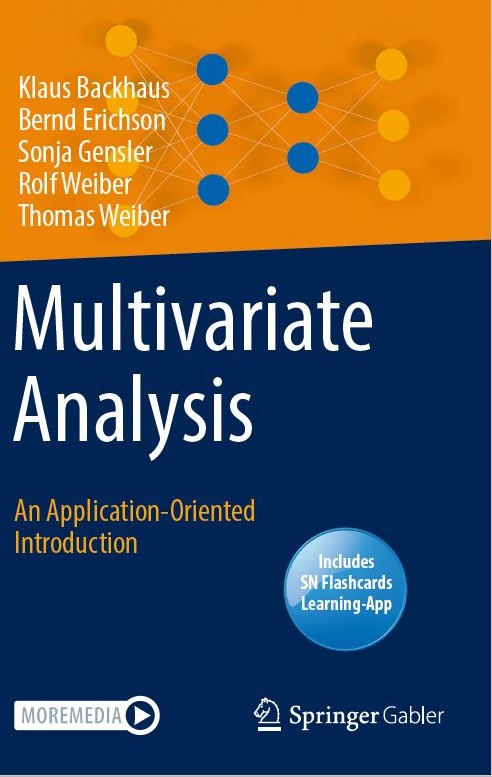
Test your knowledge.Receive immediate feedback.You find all answers in the book. Quiz | Cluster Analysis /37 57 Quiz | Cluster Analysis 1 / 37 What is the first step in performing a cluster analysis? Selection of the clustering method Interpretation of a cluster solution Selection of cluster variables Determination of the number of clusters 2 / 37 When should cluster analysis be used instead of factor analysis? Check 3 / 37 In k-means clustering, what is the target criterion for forming clusters? Maximum variance within clusters Minimum variance within clusters Minimum variance between clusters Maximum variance between clusters 4 / 37 How can you determine the number of clusters? Agglomeration schedule Dendrogramm K-Means 5 / 37 What is one of the ways to process nominally scaled variables in cluster analysis? Transform them into binary variables Convert them into ordinal variables Calculate their means and variances Use them as-is without any modification 6 / 37 Which cluster fusion algorithm is known to provide fairly good partitions and often indicates the correct number of clusters? Complete linkage Average linkage Single linkage Ward method 7 / 37 What is the first step in a cluster analysis once the cluster variables have been determined? Selecting the proximity measure and fusion algorithm Deciding the number of clusters Applying the Ward method Creating a distance matrix between all cases 8 / 37 What are the two types of hierarchical clustering? Divisive clustering Agglomerative clustering Partioning clustering 9 / 37 Why might several iterations be required in a cluster analysis? To confuse the results To save computational time To avoid using proximity measures To achieve a meaningful interpretation of the results 10 / 37 What is the purpose of calculating t-values and F-values in cluster analysis? To identify outliers To apply the elbow criterion To determine the number of clusters To assess the quality of a clustering solution and characterize the clusters 11 / 37 How do agglomerative and divisive hierarchical clustering methods differ? Agglomerative methods are faster than divisive methods. Agglomerative methods form different groups from a broad partition, while divisive methods divide a full sample into different groups. Agglomerative methods are based on a broad partition, while divisive methods form different groups from a granular partition. Divisive methods are more commonly used in practice than agglomerative methods. 12 / 37 Why is cluster analysis considered related to exploratory data analysis procedures? It helps identify the standard deviation of data. It is used for predictive modeling. It calculates the mean values of variables. It leads to suggestions for grouping objects and discovering structures in datasets. 13 / 37 What is the primary purpose of cluster analysis? To merge objects into comparable groups based on similarities To identify the standard deviation of a dataset To increase data heterogeneity To calculate the mean value of a dataset 14 / 37 In cluster analysis, what does the Minkowski metric generalize? The selection of cluster variables The Euclidean distance and city block metric The determination of the number of clusters The Pearson correlation coefficient 15 / 37 In cluster analysis, what is "intragroup homogeneity"? The degree of dissimilarity between groups The degree of dissimilarity within groups The number of groups formed The degree of similarity within groups 16 / 37 Complete-linkage clustering (furthest neighbor) calculates distances between clusters by: Taking the maximum of the distances between objects in the clusters. Taking the average of the distances between objects in the clusters. Taking the sum of the distances between objects in the clusters. Taking the minimum of the distances between objects in the clusters. 17 / 37 How are proximity measures typically categorized in cluster analysis? As similarity measures only As dissimilarity measures only As either similarity or distance measures As measures of variable correlations 18 / 37 What is the main objective of cluster analysis? To reduce the number of variables in a data set To analyze causal relationships between variables To study correlations between metric and nominal variables To group similar objects into clusters based on similarities 19 / 37 What factors should be considered when selecting cluster variables for analysis? The variables with the highest correlations The relevance, independence, and measurability of variables, among others The number of clusters to be formed The selection of a clustering method 20 / 37 What is the primary advantage of Ward's method in cluster analysis? It is suitable for identifying outliers. It works best when variables are correlated. It forms chains of objects. It often finds good partitionings and correctly assigns elements to groups. 21 / 37 What should researchers always consider when presenting the results of a cluster analysis? The stability of the results under different conditions. There should be several clustering variables with similar meaning. The number of clusters used should always be greater than 5. The date size should have at least 5,000 observations. 22 / 37 In single-linkage clustering (nearest neighbor), how is the distance between a newly formed cluster and an object calculated? By taking the mimimum of the distances between the objects in the cluster and the object By taking the sum of the distances between the objects in the cluster and the object By taking the average of the distances between the objects in the cluster and the object By taking the maximum of the distances between the objects in the cluster and the object 23 / 37 What is the aim of cluster analysis? Check 24 / 37 When transforming a nominal variable into binary variables, what does the value '1' typically represent? "Attribute value exists" "Attribute value is uncertain" "Attribute value does not exist" "Attribute value is missing" 25 / 37 What is the similarity coefficient that includes cases where both considered objects do not have certain attributes? Simple Matching (SM) similarity coefficient Jaccard similarity coefficient Russel and Rao similarity coefficient Euclidean similarity coefficient 26 / 37 What does the Euclidean distance in a cluster analysis primarily consider? Dissimilarity between objects Correlation between objects Absolute differences between objects Similarity between objects 27 / 37 In the case of binary variables, what does the Simple Matching (SM) similarity coefficient count in the numerator? The number of properties common to both objects The difference between the binary values The number of properties that only one object has The total number of properties 28 / 37 What algorithm can be used to detect outliers? Complete-linkage algorithm Ward algorithm Single-linkage algorithm 29 / 37 What is one limitation of agglomerative cluster procedures, especially for large case numbers? They work well with small datasets They require calculating a distance matrix for each clustering step They are computationally efficient They always yield accurate results 30 / 37 Which similarity coefficient measures the relative proportion of common properties in relation to the number of properties that apply to at least one of the objects under consideration? Simple Matching (SM) similarity coefficient Pearson similarity coefficient Jaccard similarity coefficient Euclidean similarity coefficient 31 / 37 What is the key criterion for clustering objects in Ward's method? Maximizing the variance between clusters Minimizing the sum of squared distances within each cluster Maximizing the number of clusters Minimizing the total number of objects in each cluster 32 / 37 What is the main characteristic of dilating clustering procedures? They form a few large groups with many small ones "left over". They tend to form chains by merging individual objects. They show no tendency to dilate or contract. They group objects into individual groups of approximately equal size. 33 / 37 How can the number of clusters in hierarchical cluster analysis be determined using the elbow criterion? By calculating t-values for each variable By comparing the results of different clustering methods By identifying a "leap" in the values of the heterogeneity measure By applying k-means cluster analysis 34 / 37 When is it recommended to use a partitioning clustering algorithm like k-means or two-step clustering? When there is a need for agglomerative clustering When the Ward method is selected When dealing with small datasets When working with a large number of cases 35 / 37 How is the similarity or dissimilarity between objects determined in cluster analysis? By calculating the mean values of variables By performing discriminant analysis By using proximity measures By conducting a factor analysis 36 / 37 What is the purpose of selecting an appropriate proximity measure in cluster analysis? To decide which variables are relevant for clustering To quantify the similarity or dissimilarity between objects To determine the number of clusters To calculate the mean values of variables 37 / 37 Why is the single-linkage method considered suitable for identifying outliers? It uses the largest value of individual distances. It forms a few large groups with many small ones "left over". It is not suitable for detecting outliers. It tends to form chains, making it effective at detecting outliers. Your score is 0% Restart quiz Learn more…MethodsServiceAbout us ContactFeedbackOrder data etc. GeneralImprintPrivacy notice